How does the show use language to convey the social identity of Max?
Language Variety
In the video clip, the chef of the restaurant introduces Max by giving the order ‘Pick up! Table twelve, four, eleven’. The chef introduces Max in the beginning without mentioning her name or anything related to her identity. This indicates Max’s identity as a working class where the proyal of her job are prioritised over her identity at the beginning of the episode, highlighting her impression on a working class member:
Max’s phonological, grammatical and lexical features contributes to her construction as a working class. In the video, Max uses the /ʧ/ sound more often when she pronounce the word ‘you’. Caroline pronounces the word ‘you’ with the /uː/ sound. This shows Max’s deviation from the use of standard english pronunciations. Standard English is known for having a high prestige and more commonly used among the upper class. Her use of non-standard english pronunciations highlights her poor level of education:
Besides phonology, Max uses non standard english lexics very often. Max pronounce words like ‘doing’ without the /ŋ/ sound when she says ‘what are you doing’ and would pronounce the word ‘you’ as ‘ya’ in contrast to Caroline which uses lexical fields from standard english. Max’s use of non standard english lexics shows the lack of prestige in her language which deviates her from being recognised as an upper class. Max uses words like ‘dude’, ‘sucker’ and ‘legit’. Her vocabulary is considered ‘harsh’ and ‘rude’, which conforms to Max’s identity as a working class because she uses these words when interacting with people from the same class but she does not use these words when interacting with Caroline. This highlights her attempt to be on the same level when interacting with Caroline but she still remains in the working class.
There were some particular grammatical features in Max’s language. Max replied to Caroline in the third episode that ‘It was like Looney Tunes funny’. Max replaced an adverb before ‘funny’ with the noun ‘looney tunes’ indicates her inability to find an adverb and her poor vocabulary choice. Max also said ‘shoe her down’ when Caroline was trying to bargain for lower shoe prices. The improper use of the noun ‘shoe’ and her transition of the noun into a verb indicates her use of inaccurate grammar which shows her identity as a working class with her use of less prestige language.
Language, Power and Stereotype
Max uses language to show her power upon others. This includes her mockery to Han (manager) when she said ‘You can’t tell an asian he made a mistake, he’ll go in the back and throw himself on a sword’. This line involves mockery, racism and culture stereotype among the Asian character Han, indicating her straightforward and power in her words that creates authority towards her character. When Earl (cashier) tries to mock Han’s culture using stereotypical language, Han instantly refutes back.
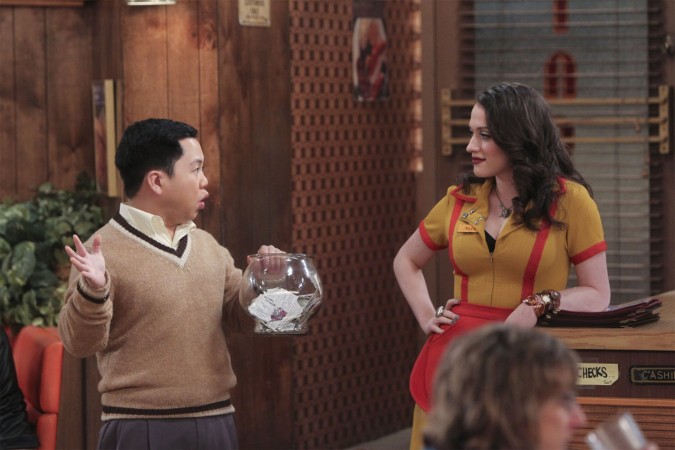
This shows the authority that Max holds within her language where no one refutes when she insults or mock someone. It distinguishes her working class from Caroline because Caroline uses more well mannered and polite words towards other characters. This also creates a stereotypical view on working class to negative impressions such as constant mockery, racism and using stereotypical language towards other people because only the characters from the working class uses these language but characters from the upper class uses more polite lexics.
Throughout the conversation between the two girls in the video below, Caroline uses long sentences to introduce her plan for a bakery shop. However, Max only uses short sentences to disagree Caroline’s idea and dominate the power in the conversation, highlighting Max’s realistic view of making money as a working class compared to Caroline’s idealistic perspective for making money. Although Caroline is trying to introduce her plan, Max asks questions repetitively to gain control in their conversation, limiting Caroline’s response to Max’s questions. Max also uses sarcasm in her language to mock Caroline’s unrealistic plan. Max says ‘Yeah, oh? 250 grands, that’s all’. The sarcastic language used indicates her experienced character being part of the working class to understand how business works in the real world which differentiates Max and Caroline’s social class.
The show demonstrates many stereotypical views of the working class. It can be seen through Max’s language when Caroline said ‘we can make extra money at other jobs like publicist, advertising executives’ and Max continued with ‘Janitors, drug mules’. This shows the stereotypical view that people from working class all does illegal jobs such as drug mules and low paid jobs such as janitors while upper class can succeed in better jobs such as publicist and advertising executives. This comparison exaggerated the difference between the jobs of the upper and working class, creating a negative impression on the professions of the working class.
 2 Broke Girls: A Sociolinguistic Analysis