How does the show use Caroline’s language to portray ideas of traditional or stereotypical femininity?
As the show is scripted, many features of natural speech associated with gendered language such as the presence of backchannel support and the use of minimal responses are often omitted, but evidence of Caroline’s convergence to female language conventions can be found in the following:
- Negative face strategies (reduced imposition, apologies) – ‘not to complain’, ‘I’m so sorry if I woke you up’, ‘it’s none of my business, but…’, ‘I’m just saying…’, ‘I’m just trying…’
- Positive face strategies (positivity, tending to needs) – ‘do you have towel or rag?’ (in order for her to clean up a spillage),
- Indirect requests/orders and implicit meanings – ‘I’m uncomfortable’ instead of stop doing that; ’You’re getting me wet’ instead of move away from me; ‘you’re Max’s boyfriend’ this is inappropriate and you should know that
- Empty adjectives and emotive evaluations and word/phrasal repentance – ‘Oh, my god’ ‘totally cute’ ‘little more cute’ ‘little less crusty’ ‘little less moist’ ‘nobody … would ever go, ever’
- Gender culture specific lexis – ‘Back up, Jersey shore’, ‘…wearing white after labor day’, (in reference to Paris Hilton) ‘she’s a hundred’ , ‘this mustard color doesn’t really go with my skintone’, ’this is Channel’
- Conversational fillers/hedges – ‘um’, ‘like’, ‘yeah’, ‘totally’,Sympathetic, supportive language and speech driven with feminist ideologies ‘you’re worth more than that’, ‘you deserve better than that guy’ and ’we really need to work on your self-esteem’
Caroline at first glance conforms to many preconceived assumptions one may make of a blonde white female portrayed in an American sitcom; in Conley’s study of the perceptions of white women, characteristics such as being submissive, ditzy, snobby, sexually easy, appearance-focused, materialistic, untrustworthy/immoral, and career-oriented were identified as common stereotypes (2012, p.48). Each of these supposed traits of her archetype are approached within the first episode, supported both visually and through her language choices.
In her debut scene Caroline’s character plays to the audience’s expectations in a variety of ways via the following discourse:
“Hi Mr. Lee, not to complain, but I think someone wore this uniform before me, like right before me. Is it possible that I could get another one? Maybe one that’s a little less moist. Also, this mustard color doesn’t really go with my skin tone, neither do the mustard stains. And these various other stains, and smells. I hope that’s clam chowder. So I think it’d be better for everyone, including my immune system, if I just keep on wearing what I’m wearing, and not the apron, ’cause this is channel. So thank you, and let’s waitress.”
Through use of the non-impositional phrase ‘not to complain’, super polite request forms like ‘is it possible that…’ ‘maybe a little less…’ and the euphemistic expression ‘I hope that’s clam chowder’ she is shown to lack conversational power – playing to Lakoff’s theory that female language is deficient and requires compensative remarks to justify producing the same point a male would make in the given situation. When taking into consideration previous research on language and gender we can make the supposition that a male would use a concise, informative request with little-to no politeness features such as ‘This uniform is dirty, can I have a different one?’
Her supposed conformity to the trope is also supported by specific lexeme choices. Her exact colour term of ‘mustard’ correlates to the idea that females have wider descriptive vocabularies and contributes to her awareness to her appearance, which happens to be the focal point of the entire prose. ‘Channel’ is a luxury brand associated with wealth and by default snobbery, and her insistence that ‘it’d be better for everyone’ if she could remain in said apparel adds to the creation of her vain persona.
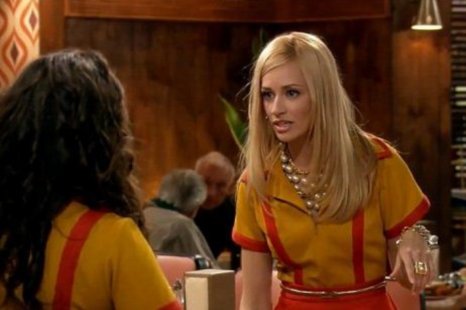
Caroline’s character is seen to carry elements of this identity throughout the episode, but as it progresses she does so notably less frequently and arguably in a less forced manner. This could be viewed as the writer’s efforts towards social perception shift – identifying her via certain traits but showing it doesn’t necessarily result in complete conformity to the outdated trope could be seen as a progressive attempt to prompt audiences to disassociate former conventions.
Stereotypes of women are often generalised from portrayals in the media – especially those of white women, Conley regards them to be ‘the most frequently objectified figures in American media’ (p.53), so in a show deemed progressive for it’s portrayals of various ethnicities, sexualities and classes it would be likely that the writers take a more socially-aware stance on the depictions of their characters.
Baxter (2007) opposes the traditional stance that females are disempowered in mixed-sex environments, in the scene shared between Caroline and Max’s boyfriend this is seen to be demonstrated as Caroline, whilst still employing indirect commands and using emotional evaluations, takes conversational power and directs/reprimands her male speaking partner.
References:
Conley, T. (2012). Beautiful, Self-Absorbed, and Shallow: People of Color Perceive White Women as an Ethnically Marked Category. Journal of Applied Social Psychology, 43(1), pp.45-56
Baxter, J. (2007). Positioning gender in discourse. Basingstoke: Palgrave Macmillan.
 2 Broke Girls: A Sociolinguistic Analysis